Oct 14, 2026Installation & Maintenance
Outdoor Floor-Standing Kiosk Quality Inspection: Full Pre-Commissioning Electrical and Ingress Checklist
Outdoor floor-standing kiosk quality inspection: rigorous pre-commissioning checklist for electrical grounding, IP65 ingress sealing, and brightness control.
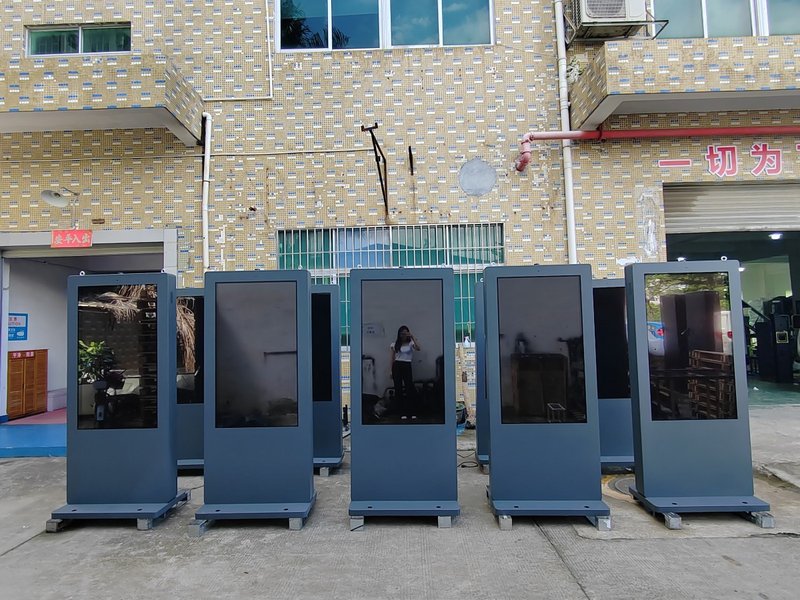
Deploying a high-performance Outdoor Floor-Standing Kiosk Quality Inspection provides commercial spaces and public venues with an all-weather digital display solution. Anyone familiar with outdoor floor-standing advertising kiosks understands that a premium-quality commercial display must comply rigorously with international manufacturing standards throughout its production process. From macroscopic chassis structural integrity to microscopic surface finishes, every engineering parameter must meet stringent industry benchmarks.
Generally, the complete assembly and pre-delivery inspection of an outdoor advertising kiosk consists of three fundamental stages: cabinet enclosure inspection, outdoor LCD display panel verification, and integrated software/electronic system testing. The comprehensive inspection workflow is detailed below:
1. Cabinet Enclosure Assembly and Enclosure Inspection with a Outdoor Floor-Standing Kiosk Quality Inspection
Ingress Protection (IP65) and Weld Sealing:
The enclosure is the kiosk's first line of defense against exterior environmental stresses. For outdoor deployments, IP65 is the universally recognized international benchmark. Enclosure inspections must verify whether structural silicone sealant along internal weld seams is uniformly applied, ensuring that condensation and rainwater cannot penetrate the cabinet welded joints during prolonged outdoor exposure.
Mounting Brackets and Fastener Integrity:
Inspect internal mounting brackets and verify that cage nuts and weld studs adhere tightly to the frame. Check all mounting holes against dimensional drawings to guarantee precise component alignment and secure fastening.
Screw Holes and Waterproof Gasket Sealing:
Examine chassis fastener positions and structural nut plates. Scrutinize the clearance between screw holes and silicone sealant beads. If sealant debonding, gaps, or signs of water ingress are discovered, disassemble the fasteners immediately and reapply industrial-grade waterproof silicone sealant thoroughly.
Surface Cleanliness and Protective Glass Inspection:
Inspect the exterior and interior cleanliness of the entire machine. Check whether there is trapped dust or particulate contamination behind the protective glass. Run a hand across the inner glass surface to verify flat, uniform lamination without localized pressure points. Apply gentle pressure across the surface to detect any air pockets, delamination bubbles, or moisture bubbles; the presence of bubbles indicates an unacceptable failure in optical bonding or glass assembly, which severely impairs touch responsiveness and visual uniformity.
Enclosure Door Fit, Compression Strips, and Security Locks:
Open the enclosure maintenance door and attempt to latch and close the door panel using one hand. If the door panel binds against the compression weatherstripping and resists smooth latching even under firm pressure, the door frame tolerances fail commercial anti-theft and weatherproofing standards. This indicates either structural door warping or misaligned cam-lock hardware that must be reworked.
Operational Acoustics, Vibration, and Thermal Insulation:
Measure system acoustic noise during full operation. Verify that thermal insulation foam lining the inner chassis walls effectively blocks external ambient heat gain. If the air conditioner or cooling fan array produces excessive decibels while the insulation foam fails to regulate interior cabinet temperatures, the thermal dissipation ducting and acoustic baffling architecture must be re-engineered.
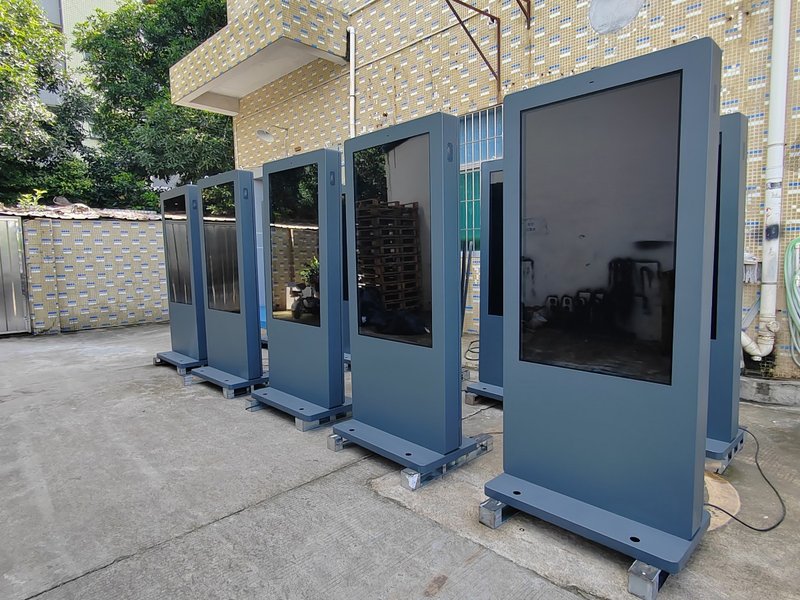
2. Outdoor LCD Display Panel Quality Inspection Standards
Glass Perimeter Moisture and Hermetic Barrier Verification:
Wipe down the edges of the protective glass using a cleanroom-grade lint-free cloth. Inspect the entire perimeter for microscopic water droplets or condensation traces. If moisture droplets appear around the glass border or adjacent mounting screws, reseal the perimeter immediately with industrial silicone sealant.
Optical Air Gap and Cushioning Strip Tolerances:
Use precision vernier calipers to measure the clearance between the inner surface of the protective glass and the active LCD cell. If the foam cushioning strip or air gap exceeds 1.0 mm, special attention must be given to the forced-air cooling duct design to prevent optical distortion, thermal trapping, or dust ingress.
Internal Driver Boards, Wiring Harnesses, and Screen Cleanliness:
Inspect internal electronic controller boards, scalar boards, and cabling pathways to ensure neat, organized dressing and clear labeling. Inspect the active LCD panel surface under high-intensity inspection lamps to guarantee 100% absence of dust, fingerprints, scratches, or cosmetic blemishes.
Panel Bezel Clamping Strips and Structural Support Frames:
Carefully inspect the LCD panel clamping brackets and internal chassis chassis supports. Follow the orientation arrows indicated on the backlight chassis to verify that the LCD panel is mounted in its intended, strain-free mechanical orientation.
Thermal Fans, Insulation Foam, and Ingress Protection Grilles:
Examine the industrial cooling fans, thermal insulation lining, and dust filtration mesh. Authentic, professional display manufacturers employ industrial-grade high-CFM pulse-width modulated (PWM) fans, flame-retardant thermal insulation, and multi-stage washable stainless/aluminum filters.
Power Supplies and Core Electronic Subsystems:
Inspect active driver boards, multimedia decoding motherboards, terminal connection blocks, and industrial power supply units (PSUs). Thoroughly cross-reference all electronic specifications against the certified Master Electronic Configuration Schedule.
3. Customized Software Commissioning and System Validation
For bespoke or customized outdoor floor-standing advertising kiosks, comprehensive software commissioning and firmware configuration must be completed before shipping.
Custom hardware variants—such as digital newspaper reading kiosks, highway toll plaza display systems, or interactive smart city kiosks with remote IoT telemetry—differ substantially from standard commercial display kiosks equipped merely with generic HDMI and VGA video inputs. Consequently, custom configurations place exceptionally high demands on wireless communication subsystems, requiring rigorous throughput and signal strength testing for industrial Wi-Fi and 3G/4G/5G cellular external antennas to guarantee reliable continuous data transmission. In conclusion, selecting a professional Outdoor Floor-Standing Kiosk Quality Inspection guarantees long-term operational stability, superior sunlight readability, and maximum commercial impact.
Looking for customized Outdoor Floor-Standing Kiosk Quality Inspection solutions, high-brightness outdoor digital signage kiosks, or weatherproof commercial displays? Feel free to contact the ZXTLCD engineering team for detailed technical specifications, mounting drawings, and volume pricing.